 |
Evolutionary
Psychology
Darwin's
(1959) Theory of Evolution by Natural Selection
Successful organisms survive because they have a
genetic/physical trait
that allows them to better adapt to their changed
environment. Having a successful adaptation - is largely
down to luck, as species can neither control their genetics nor
their environment.
Those individuals within a species that have the necessary
adaptation, called a genetic variation, have a better
ability in a changed environment to reproduce offspring that can
themselves survive. Variations come about either as a
consequence of genetic inheritance from the biological parents,
or because of minor, random, genetic changes in an organism.
These are called mutations.
Species are made up/not made up of individuals who, by chance,
have this genetic variation. These individuals survive, while
others don't. Variations and adaptations are therefore
genetically inherited and passed from generation to generation.
After a certain period of time the adapted species will appear
so different from the original species that ultimately a new
species has evolved.
Natural selection best describes those species whose physical
characteristics and behaviours are adapted to fit its
changing/changed environment. These are the ones that survive.
Hence Darwin's idea of natural selection, and the survival of
the fittest. Those who survive are those who have genetically
adapted a physical characteristic or behaviour to fit their
changed environment. It is environment that selects who
survives, and who does not.
|
|
Genetics
Humans inherit 23 pairs of
chromosomes
from male & female parent. 23rd pairing determines sex. XX =
female. XY = male. Chromosomes contain genes (10-20K
each), which create protein, needed to build our bodily
structures/functions. A gene contains our biological blueprint
in terms of DNA (deoxyribonucleic acid). DNA
holds the body's protein building instructions, or bases
(A, T, C and G). The results of
which make us 99.9% similar, but 0.1% different.
Psychology sees this 0.1% in terms of our
individual
differences (intelligence,
atypical
behaviours, and (possibly)
personality).
|
Empirical evidence for
Darwin's Theory?
Kettlewell
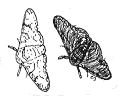
(1955) observations on the peppered moth.
|
|
Applications.
Biological approach looks to a physical cause behind our
thoughts, feelings and behaviour. 'Physical cause' is a
bodily process/function that has suffered damage, disease,
accident or been genetically influenced in some way. If
something has a physical cause, it is treated with a
physical therapy, from a physical point of view.
Thus:
Schizophrenia:
the dopamine
hypothesis (Iverson, 1979). Treatment:
neuroleptics.
Depression:
Frustration of hormones such as
serotonin,
dopamine and
noradrenaline,
important to mood state. Treatment,anti-depressants.
Controversial. Controls mood state artificially; real cause environment,
still there!
|
|
|
Test your knowledge and generalisation skills with the Biological Approach
Crossword
Printable Version or Online Interactive Version
Now go on and test your knowledge with
the Biological Approach Quiz
|