
| The
Cognitive Approach At A Glance If you need to write about this approach it is a good idea to know a definition, and then be able to elaborate on key features. You may also be called upon to discuss applications and limitations. All this is schematically represented below. Use the glossary, as before, to help you. |
| The cognitive approach involves the study of our mediational processes. These allow us to take in information from our world, and actively process this information to make the most effective response to our world. Mediational processes come between an environmental stimulus, and our response to it. |
| The
Computer Analogy (If you have trouble with the animation below, this link will take you to the Glossary entry which includes a text version of the diagram)
(X) = Our active information processes of perception, attention, language, memory, and thinking come between stimulus and response |

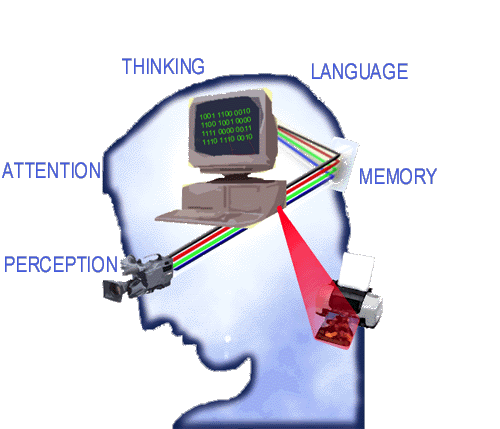
Click on the active information processes in the above image to find out more information from the glossary.
|
|
||
|
|||
Before undertaking the Cognitive Approach Crossword you might wish to know the answers to the Behaviourist Approach Crossword from last section. We hid this somewhere, but heres a big clue: If you've already clicked on the link above then you will already know how to find it!
Test your knowledge and generalisation skills with the Cognitive Approach Crossword!
Printable Version or Interactive Online Version

Back to Cognitive overview






Click on any underlined text to jump to that topic or to jump to the glossary description of that item.
Research into dyslexia and Myers-Irlen syndrome suggests that changing the background colour upon which words are written can often benefit the reader. If you feel this applies to you please select your preferred colour from the DMI EasiReader © below.
Click here to go to the DMI EasiReader information page


[
Sign
my Guestbook] - [Read
my Guestbook ]